Verified Local Business Leads
You describe who you want to reach. Every matching business gets checked against that description, a working email gets sourced and deliverability-tested, and the leads that pass arrive with a receipt itemizing everything that was cut and why. Finding local businesses is the easy part; this is built for the deciding.
Most sources in this category work the other way around: they hand you everything they found and leave you to work out who's worth the email, bounce-checking included. We built this so the list arrives already decided, with the reasoning attached.
What does "verified" mean here?
"Verified" gets used loosely across this category. Here it means something specific: every business is checked against your targeting criteria at the time your campaign runs (not matched against a stale export), and every email is deliverability-tested before it's charged as a lead. Businesses that don't fit, duplicates, and unconfirmable emails all get cut before billing rather than discovered after you've sent to them.
A real sample run, cuts included
One campaign run found 214 matching businesses for a target vertical and geography. After the fit check and email verification, 87 leads passed and were delivered. The other 127 were cut for specific, itemized reasons: wrong fit, duplicates, or emails that didn't clear deliverability testing.
That's roughly a 40% pass rate on a single sample run, not a general benchmark for every vertical or city. Here is what the validated set looks like inside the product, from a real med-spa run in Charlotte (contact details masked):
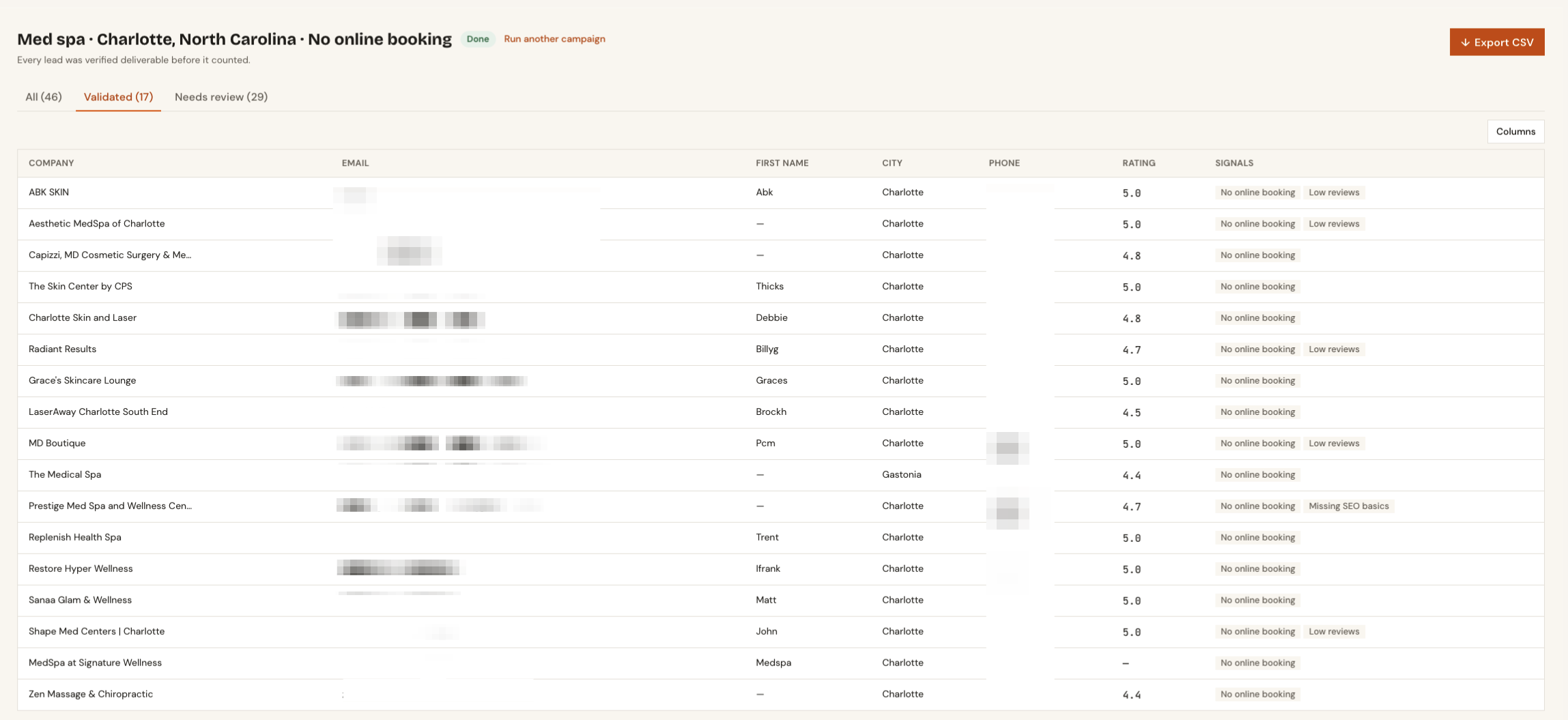
The number that matters for your campaign is what your own niche and geography return, which is exactly what the free tier is for. Pass rates move with how narrow your targeting is: a broad category-plus-city search generally clears more of the field than a search stacked with several targeting signals at once, since each extra filter is another chance for a business to get cut.
What gets checked on every business?
- Fit against your description. A per-business check confirms the candidate actually matches what you described, not just category and city.
- Targeting signals a database field can't express. Website presence, review count, independent vs. chain, booking software or its absence, and other criteria that separate a business that actually fits from one that only technically matches. Each delivered lead carries the signal that qualified it.
- Email sourcing and verification. A real email is located and deliverability-tested before it counts toward your total.
- A receipt. Every cut lead is itemized with the reason it didn't pass, so the list is never a black box.
Why does the receipt matter?
Every vendor in this category claims quality, and a claim can't beat a claim. So instead of asking you to believe the list, we show the cuts: every removed candidate, listed with its reason. You can audit the selection instead of taking it on faith, and when a pass rate looks low for your niche, the receipt tells you exactly where the field thinned out. There's no spreadsheet detective work waiting after the send, because the deciding already happened, in the open, before delivery.
How you'd actually use it
Describe the target: a vertical, a metro, and any signals that matter (no website, review count, independent vs. chain, whatever narrows it for your campaign). The system finds every matching business, checks fit, sources and verifies an email, and delivers the passed leads with a receipt for everything cut. From there the list is yours to load into whatever sender you already use; sending itself isn't something we handle, and that's on purpose.
Pricing, plainly
25 free verified leads at signup, no card required. After that, prepaid credit packs with no subscription. A flat 1 credit = 1 validated lead, in every mode:
| Pack | Price | Works out to |
|---|---|---|
| 240 credits | $29 | about $0.12 per validated lead |
| 750 credits | $79 | about $0.11 per validated lead |
| 2,000 credits | $199 | about $0.10 per validated lead |
Cut leads are never charged. Full breakdown of the model is on the pay-per-validated-lead page. If you want to test the free tier first, see what's included in the free 25 leads.
Who this is built for
We built this for cold-email agencies and lead-gen consultancies running campaigns across multiple verticals and metros, for in-house SDR and growth teams selling to local businesses, and for founder-led sales past the hand-research stage. See the agency-specific breakdown for how the pricing and receipts map onto agency economics, how the no-website signal works as one targeting filter among several, or, if your offer is booking and automation software, the GoHighLevel-agency breakdown of the no-online-booking filter.
This page covers the local-business mode; the same engine also runs on online stores and agencies, people at newly launched companies, and YouTube and TikTok creators.
We didn't build it for enterprise national-account selling (that's Apollo or ZoomInfo territory), and we didn't build it for anyone who wants the sending done for them. What you get is a clean list; the sending stays with you.
For teams building outreach on top of Claude Code, Codex, or a similar agent stack, the same discover-verify-export flow is available as an MCP server and REST API.
FAQ
How is this different from a scraper or a list broker? A scraper or broker hands you everything it found and leaves the fit call to you. This checks each business against your described target and tests email deliverability before you're charged for a lead, and gives you a receipt for everything that got cut along the way.
Will it work for my specific niche and city? Coverage varies by vertical and metro. The reliable way to find out is running your exact niche and city on the free 25 leads rather than relying on a general claim, since results genuinely differ across markets.
What if a lead bounces after I've already paid and sent to it? Every email is deliverability-tested before it's charged, which catches dead or non-existent addresses ahead of time. It doesn't guarantee a reply, but it means what you paid for was confirmed reachable at verification time.
How is this different from Apollo or a similar contact database? Contact databases index firmographic fields captured by a national crawl, and what you export is typically unverified. This checks each business against the target you described, at run time, including criteria a database field can't express, and only leads that pass are billed.